Call us now


Quick answer: a buffalo's calving interval is the number of days from one calving to the next. Because buffalo pregnancy lasts about 310 days, a practical target is about 13–14 months (roughly 400–430 days), which means getting her pregnant again within about 90–120 days of calving. Long-term records from the ICAR-NDRI Murrah herd in Karnal averaged about 455 days (around 15 months), and almost all of the difference between a short and a long interval came from the service period: the days from calving to a successful conception. So the way to cut the interval is not to change the pregnancy. It is to get her uterus clean, her body condition and minerals right, catch her heat, inseminate on time and confirm pregnancy early.
Calving interval (in Hindi, ब्यांत अंतराल, the gap between two calvings) is the simplest measure of whether a buffalo is earning her keep. Every extra month between calvings means a month more of feeding a buffalo that is in late lactation or dry, a later next calf, and fewer lactations in her lifetime. A buffalo that calves every 13–14 months gives you far more milk and calves over her life than one that calves every 17–18 months, even if their daily yields are the same.
Calving interval has only two parts:
In the NDRI path-analysis study of 1,277 Murrah records, the service period explained about 99% of the variation in calving interval. Gestation length hardly mattered. Here is what different service periods mean in practice (gestation taken as ~310 days):
| Conceives at (days after calving) | Calving interval | About |
|---|---|---|
| 90 days | ~400 days | 13 months |
| 120 days | ~430 days | 14 months |
| 150 days | ~460 days | 15 months |
| 210 days | ~520 days | 17 months |
Every heat that is missed or every insemination that fails adds roughly one 21-day cycle, about three weeks, to the interval. Two missed heats and one failed AI already push a 13-month buffalo to more than 15 months.
Buffaloes breed best in the cooler months, roughly September to February. In the hot months, heat signs become weak or disappear. A buffalo that is not pregnant by the end of the cool season can lose several months waiting for the next one. In the NDRI Murrah data, the season of calving had a significant effect on both service period and calving interval. Our buffalo breeding season guide explains the best months and how to prepare.
Buffaloes often show heat quietly, mostly at night or early morning, and rarely mount each other. Many "non-cycling" buffaloes are actually cycling but not being seen. Read silent heat: why animals fail to show heat signs.
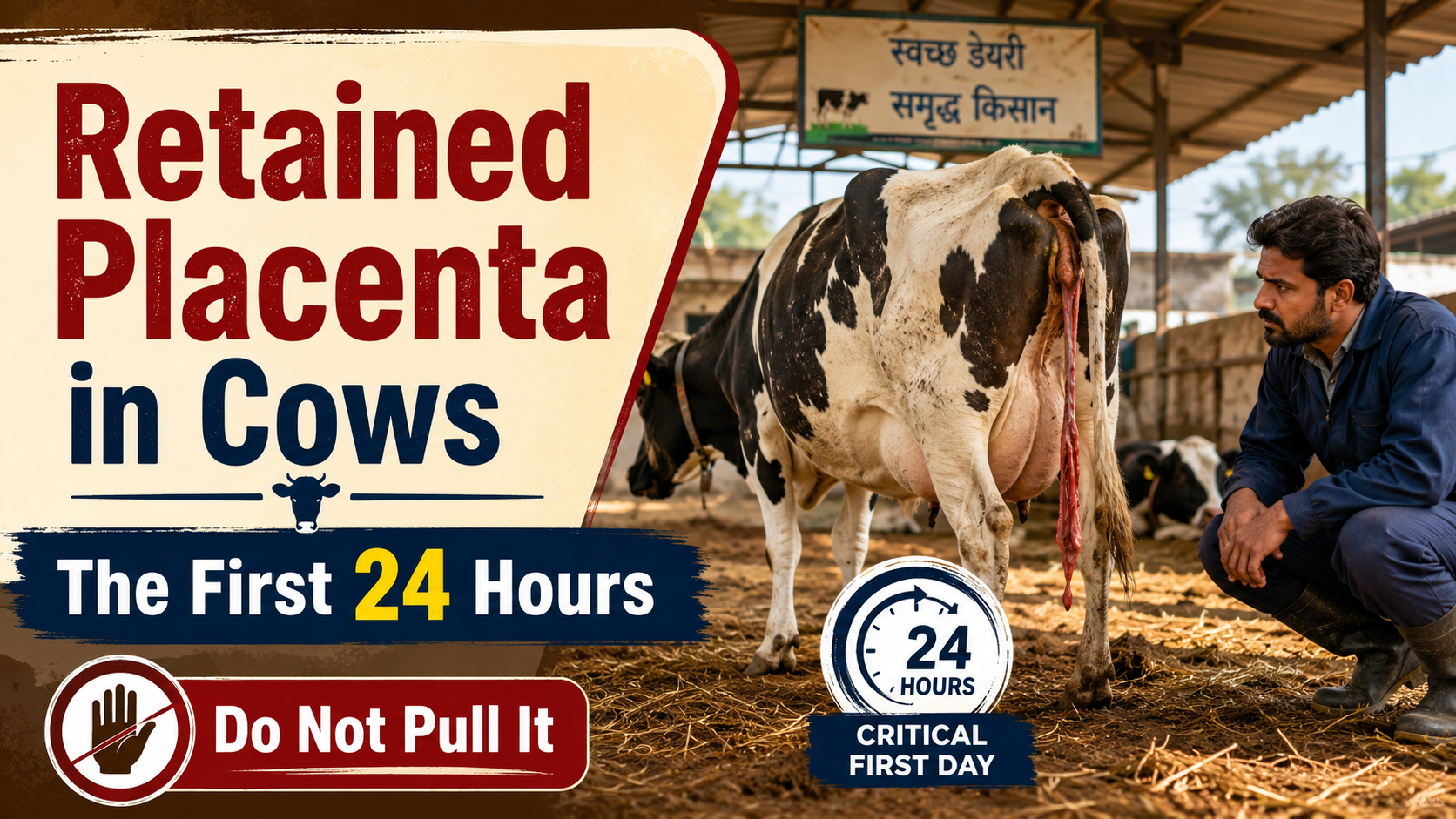
Retained placenta, a difficult calving, or a dirty or white discharge delay uterine involution and lower conception at the first services. See retained placenta: the first 24 hours and white discharge after calving (metritis and endometritis).
Buffaloes that lose too much condition after calving, or that are short of phosphorus, copper, zinc and other minerals, often do not come back into heat (postpartum anoestrus). NDDB lists a shorter inter-calving period among the benefits of feeding an area-specific mineral mixture. In ICAR-NIANP field trials in Karnataka, about 80–90% of animals started cycling within 70 days of area-specific mineral supplementation. Our anoestrus guide covers the causes in detail.
If nobody checks whether the AI worked, a buffalo that did not conceive may be treated as pregnant for months. Early pregnancy diagnosis is one of the cheapest ways to shorten the interval.
A buffalo that keeps returning to heat after AI usually has a uterine infection, an AI timing problem or a nutrition gap. See why an animal is not conceiving.
If a buffalo shows no heat by about 90 days after calving, ask your veterinarian for a reproductive examination. Common findings are a missed silent heat, an inactive ovary from poor nutrition, or a uterine infection. Hormone-based heat-induction or synchronisation protocols are effective in the right animal, but they must be prescribed and given by a veterinarian after examination. Never inject hormones on your own.
Because buffaloes breed best from about September to February, a buffalo that calves in late summer or the monsoon has the whole cool season ahead to conceive. One that calves in winter may reach 60–90 days just as the hot months begin. For winter-calved buffaloes, be extra careful with uterine recovery and heat detection so that she conceives before summer. Keep summer buffaloes cool with shade, water and wallowing, because heat stress suppresses heat signs.
A practical target is about 13–14 months. Organised Murrah herds at ICAR-NDRI averaged about 15 months (455 days). Buffaloes that miss the cool breeding season can stretch to 17–18 months or more.
About 310 days, roughly 10 months. That is around a month longer than a cow. NDRI recorded 309.5 days in Murrah buffaloes.
Rarely. A 12-month interval would need conception within about 55 days of calving, before most buffaloes have recovered and are back in heat. Aim for 13–14 months instead. That alone is a big improvement on most farms.
It helps when minerals are the missing link, which is common in Indian rations. NDDB lists a reduced inter-calving period among the benefits of area-specific mineral mixture. Minerals work alongside good feeding, heat detection and timely AI, not instead of them.
Ask your vet for an ultrasound check from about 30 days after AI, or a rectal check from about 45 days, with a recheck around day 60.
More in this series: One calf a year: the habit that decides dairy profit; post-calving care: the first 30 days; age at first calving in heifers; which Cattle Remedies product for which problem.
Reviewed for accuracy against the sources above on 22 October 2026. This article is general educational information for dairy farmers and is not a substitute for veterinary advice. Reproductive examinations, pregnancy diagnosis and any hormone treatment must be done by a qualified veterinarian. Cattle Remedies products are supportive care and work best alongside good feeding, hygiene and veterinary management.
By Cattle Remedies