Quick answer
The best digestive powder for cattle in India is one that matches the problem you are actually seeing. For poor appetite and a sluggish rumen after calving, heat, transport or a feed change, use a rumen and appetite powder fed for several days, such as Cattle Remedies RUMINOVA™ (50 g twice daily for a cow or buffalo). For a quick appetite boost in a sick or recovering animal, a bolus such as Cattle Remedies GRAZUP™ is easier to dose. Bloat needs a dedicated anti-bloat product such as Cattle Remedies BLOATGUL™ Plus, and diarrhoea with fever or blood needs a veterinarian. A digestive powder never replaces fixing the ration.
Why cattle go off feed
A cow's rumen is a fermentation tank run by microbes. Anything that upsets those microbes, or the cow's comfort, shows up first as lower feed intake, less cud-chewing and a drop in milk. The usual triggers on Indian farms are:
- Sudden ration change: new green fodder, a jump in grain or concentrate, or spoiled or mouldy feed. This "simple indigestion" often affects several animals at once and usually settles within a day or two once the feed is corrected.
- Calving and early lactation: appetite naturally dips around calving, just when energy needs rise. See ketosis in dairy cows.
- Heat stress: cattle and buffaloes eat less in hot, humid weather.
- Transport, illness and medicines: fever, pain and some treatments reduce appetite.
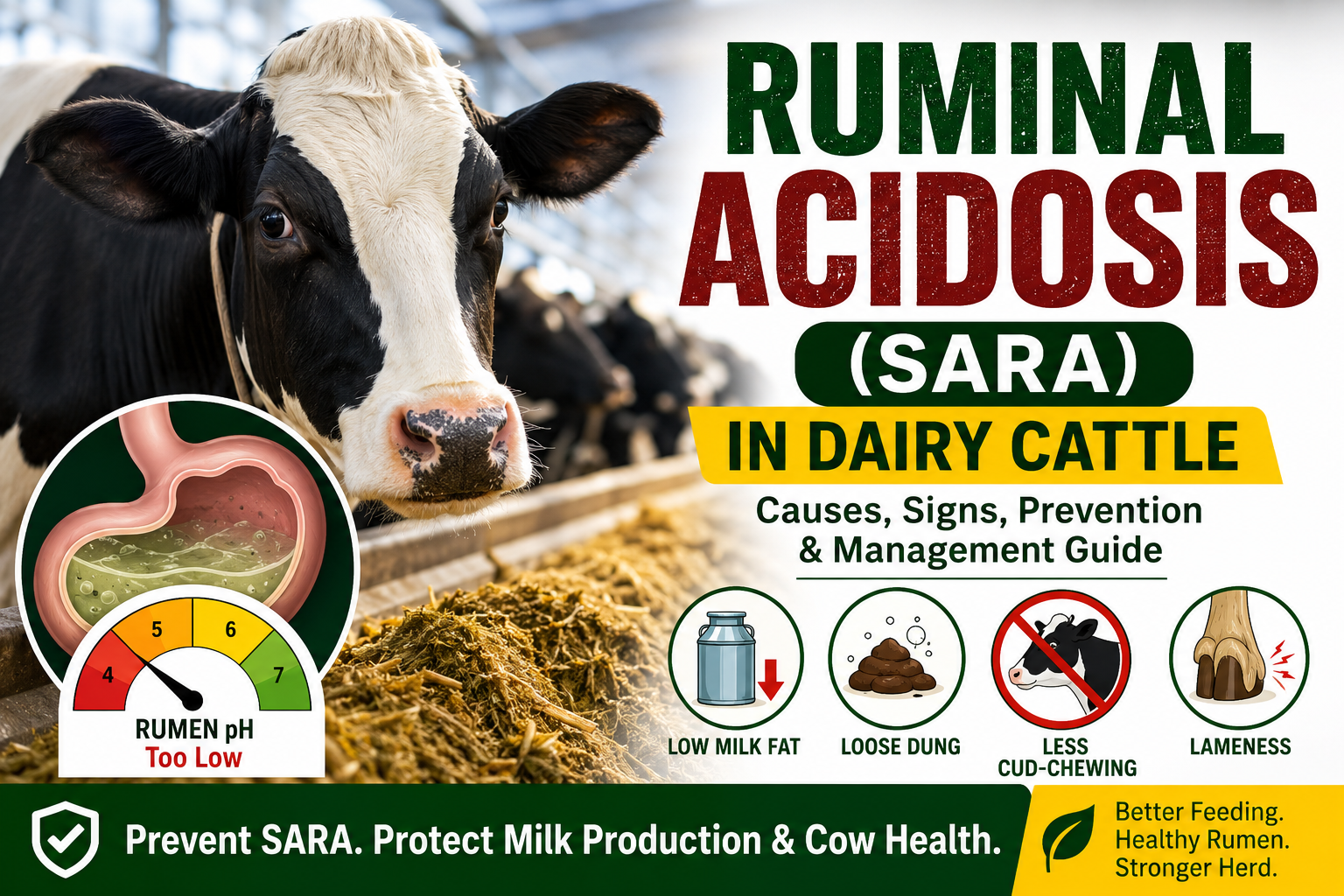
- Too much grain, too little fibre: this lowers rumen pH and can lead to acidosis. See ruminal acidosis (SARA).
- Worms and liver flukes, which quietly reduce appetite and condition.
For a full checklist, read cow not eating? appetite and digestion fixes.
How to choose a digestive supplement: 7 criteria
1. Match the product to the problem
- Poor appetite, slow rumen, stress or feed change: a rumen and appetite powder or bolus.
- Bloat (swollen left side, discomfort): a specific anti-bloat liquid, plus a vet if the animal is distressed.
- Diarrhoea: find the cause first. Infectious diarrhoea, especially with fever or blood, needs veterinary treatment rather than a digestive powder.
- Off feed with fever, pain or no dung: call the vet first; digestive products come after the diagnosis.
2. Look at what is inside
- Traditional digestive herbs and spices such as ginger, ajwain, black pepper, fennel, cumin and hing are widely used in Indian formulations to stimulate appetite.
- Live yeast (Saccharomyces cerevisiae) is one of the best-studied rumen additives: a meta-analysis of 157 feeding experiments found it raised rumen pH, improved organic matter digestibility and increased dry matter intake and milk yield on average, although results vary with diet and dose.
- Probiotics and chelated trace minerals support gut function and appetite in convalescent animals.
- Choose products that declare their composition and dose on the label.
3. Pick the right form
- Powder: easy to mix into feed for several days or longer, which suits a whole group of animals after a ration change or in summer.
- Bolus: a precise dose for one animal that is not eating its feed, so it suits sick or recovering animals.
- Liquid drench: fast action for acute problems such as bloat.
4. Safety and milk withdrawal
For daily use in milking animals, prefer herbal formulations whose label states no milk withdrawal period. Antimicrobial products for diarrhoea (for example tablets or boluses with antibiotics) are medicines: use them only on a vet's advice and follow their withdrawal rules.
5. A clear, realistic dose
The label should give the dose for cows and buffaloes, for small ruminants, and how long to give it. Be wary of products that promise results from a single dose.
6. Manufacturing quality
Look for certified manufacturing (such as ISO, GMP, AYUSH or FAMI-QS), batch numbers and expiry dates.
7. Fix the ration as well
No supplement can make up for a poor ration. NDDB advises changing feeds gradually rather than suddenly, chaffing fodder to improve digestibility, and feeding an area-specific mineral mixture. A balanced ration with enough long fibre keeps the rumen working.
Cattle Remedies digestive range compared
RUMINOVA™: best for daily appetite and rumen support
- What it is: a digestive and appetite enhancer powder for cattle and other livestock, and an improved Cattle Remedies formulation.
- Use for: poor appetite, post-calving recovery, heat stress, feed or ration changes, transport stress, poor body condition, low milk due to poor feed intake, and digestive disturbances.
- Dose (label): cow and buffalo 50 g twice daily; small animals 25 g twice daily; or as advised by your veterinarian or nutritionist.
- Packs: 250 g, 500 g and 1 kg. Also available on Amazon.
GRAZUP™: appetite and digestive bolus
- What it is: a bolus with phytocompounds of ginger, ajwain, black pepper, fennel, cumin and hing, plus Saccharomyces cerevisiae, Lactobacillus sporogenes and chelated trace minerals.
- Use for: anorexia, indigestion, impaction and diarrhoea-related appetite loss; convalescence, weakness and debility; feed or season changes and drought stress.
- Dose (label): cow and buffalo 2 boluses twice daily for 3–5 days; small animals 1 bolus twice daily for 3–5 days.
- Pack: 12 × 4 boluses.
BLOATGUL™ Plus: for bloat and flatulence
- What it is: an anti-bloat and anti-flatulent formulation with Kabila, Hing, Tarpeen oil, Alsi oil and Simethicone, and an improved Cattle Remedies formulation.
- Use for: gaseous and frothy bloat, colic and impaction support, and preventing repeat flatulence.
- Dose (label): cow and buffalo 100 ml orally or intra-ruminally; sheep and goats 10–20 ml mixed with an equal volume of clean water.
- Severe bloat with breathing difficulty is an emergency, so call a vet. See early detection of bloat.
When the problem is diarrhoea or the liver
- Diarrhoea and dysentery caused by bacteria or protozoa may need Cattle Remedies IDAVET™-DS, a norfloxacin and tinidazole bolus. It is an antimicrobial medicine, not a herbal digestive, so use it on veterinary advice. For calves, see calf scours.
- Poor appetite linked to liver stress (after fluke treatment, illness or heavy lactation) is better supported with a liver tonic such as Cattle Remedies HEPRICH™. See the best liver tonic for cattle in India.
Quick picker
- Cow off feed after calving, heat or a feed change: RUMINOVA™, fed for several days.
- One sick or recovering animal not eating: GRAZUP™ bolus for 3–5 days.
- Swollen left side or frothy bloat: BLOATGUL™ Plus, and a vet if she is distressed.
- Diarrhoea with fever or blood: call the vet (IDAVET™-DS only if prescribed).
- Weak, recovering animal with poor appetite: add a liver tonic such as HEPRICH™.
When to call the vet instead
- No dung, or very little, for 12–24 hours, or a hard, painful belly
- Fever, or a cow that stops eating completely
- Bloat with breathing difficulty, or bloat that keeps coming back
- Blood in the dung, or diarrhoea in a calf that is weak or not sucking
- Off feed after possible swallowing of metal; see hardware disease
- Heavy drooling while off feed; see excessive salivation in cattle
Frequently asked questions
Which is the best digestive powder for cows in India?
Choose a rumen and appetite powder with a declared herbal composition, a clear dose and no milk withdrawal, and fix the ration at the same time. Cattle Remedies RUMINOVA™ is designed for this daily role, at 50 g twice daily for cows and buffaloes.
How long should I give a digestive powder?
Follow the label and your vet. Powders are usually fed for several days during and after a stress period such as calving, heat or a feed change. If the cow is still off feed after 2–3 days, or gets worse, have her examined.
Can I give a digestive powder and a bolus together?
Usually one appetite product is enough. Use a bolus for an individual animal that is not eating its feed, and a powder for animals still eating some feed or for a group. Ask your vet before combining products.
Is a digestive powder safe for pregnant and milking cows?
Herbal products labelled with no milk withdrawal are designed for milking animals; check the label, and ask your vet for pregnant animals or those on other treatment.
Does a digestive powder help with bloat?
Appetite powders support rumen function but are not an emergency bloat treatment. Use a dedicated anti-bloat product such as BLOATGUL™ Plus, and call a vet for severe bloat.
References: Simple Indigestion in Ruminants, MSD Veterinary Manual; Bloat in Ruminants, MSD Veterinary Manual; Feeding of Dairy Animals, NDDB Farmers' Corner; Desnoyers et al. 2009, meta-analysis of Saccharomyces cerevisiae supplementation in ruminants, Journal of Dairy Science.
This guide is general educational information. Ask your veterinarian or nutritionist to diagnose appetite and digestive problems in your herd.
By Cattle Remedies